Showing posts with label Batrep. Show all posts

Sunday, 20 September 2020

Thermopylae 2500th Anniversary Game Day

 To commemorate the 2500th anniversary of the battle of Thermopylae, the Thailand DBMM group held a small game day. Four players, DBMM 200, round robin style. Unfortunately no-one in the group has an Achaemenid Persian army, so we had to content ourselves with four armies from the Aegean world in 480 BC, and had ourselves a spear fest.

Runners and Riders

Myself (Bob):. Early Hoplite Greek (Athens): A big command of 22 hoplites, a small command of 10 hoplites and the best light troops, and a Thessalian ally with 6 light horse (including the general).

Anthony: Lycian: A big command of spearmen, with 6 fast blades. A command with another block of spearmen and 4 CvO and a light command of AxO and Ps.

Nash: Highland Thracian. One huge command of PsS and PsI with a few AxS and two smaller commands of Ps, Ax and a few LH.

Peter: Early Hoplite Greek (Spartan). This list pretty much writes itself at 200pts. It had one large command of SpS backed by SpO and a smaller command with more Sp and a few Ps.


Round One

Game 1:. Athens vs Thrace.


The lines close. Game 2 in background

The Thracians were hoping to defend, but ended up attacking. I just picked an open field for my terrain choice, so the only terrain was one difficult hill on my left. My plan was pretty simple mask the hill, extend my line to the table edge on the right, then advance and push the Thracians off the table. The Thracians plan was to confront my hoplite line with a line of PsS backed by I, hoping to break up the line and get a few kills with overlaps and his S bonus. Meanwhile another horde of Ps would swarm over the hill and LH would come round on my extreme left.


The line of Ps and Sp quickly collided, with poor Thracian dice seeing a number of Ps being spent and the hoplite line holding firm. I moved my reserve Thessalian ally over to reinforce the left, while retreating my heavily outnumbered psiloi from the hill. The Thracians surged up onto the hill, but then the advance was stymied by several bounds of poor PIPs. The Thessalians and spears on the left polished off the Thracian light horse, while the hoplite line continued pushing forwards and spending Ps. One Thracian Ps did make a breakthrough on my extreme right, but it was too little too late and the hoplites polished off the last few opposing Ps to reach the 20 spent needed to break the command and army.

Hoplite line totally broken up

The Thracians only killed two hoplites, but did completely break up the line and most of the hoplites ending up surging forwards impetuously in isolated columns. Had there been reserves positioned to counter attack, the Athenians could have been in trouble.

Result: Athens 25 - Thrace 0.


Game 2: Sparta vs Lycia

Spartans top huddle btetween crag and baseline


The Spartans were very worried about being surrounded and formed a defensive perimeter on the base edge (even if it doesn't look that way in the photo) anchored on a craggy hill. The Lycians were eventually able to take the hill but were still unable to pierce the Spartan defenses with their swordsmen failing to make an impact. 

Result Lycians 13 : Sparta 12.


Round Two

Game 1: Athens vs Sparta

A good old fashioned local derby this one. Spartans invaded, and placed a sea on my right. I placed two difficult hills on their base edge to disrupt their deployment, and a gentle hill in the center for me to defend.

Deployment

Getting the win in this game would be tricky. The superior Spartan hoplites would easily defeat mine in a frontal fight, though they'd have a hard time defending their flanks, and if I formed too deep, they might use their regular maneuverability to march round my line. If the Spartans defended they'd be hard to defeat within the time limit even though I had enough light troops to take one of the hills they'd anchor on. Therefore I'd have to lure them out by offering them something they could attack, while making sure I could hold on long enough to turn their flank.


Spartans advance

So I deployed a two deep line of hoplites between the sea and the central hill to act as bait, with a large force 3 deep on the hill to be a strong anchor and flank threat, or to advance and pin the Spartans frontally if they
defended. I sent the Thessalian on a flank march across the sea in improvised shipping. The Spartans placed their large command in a line resting on the sea, with a deep column on their right. Their smaller command was placed further back on their right with some Ps thown out on the flank.

Spartans advance in silence


The Spartan line advanced along the sea, bringing their baggage with them, while the Athenian spearmen held position as their light troops moved round to drive off their Spartan opposite numbers. These fell back while the hoplites from the small Spartan command moved behind their main line to protect their rear from the impending flank march. The Thessalians did arrive, but the Spartan second line fended them off easily. However, this left the main Spartan command facing two Athenian ones, with very stretched flank protection. 

Spartans totally surrounded

The lines clashed by the sea, with Spartans killing a fair number of Athenians. However the latter also bagged a couple of Spartiates, and turned the right of the Spartan line and started rolling it up. Meanwhile the force on the hill pivoted and overran the Spartan flank protection breaking the army.

Result: Athens 23 - Sparta 2. 


Game 2: Lycia vs Thrace

Nash's lunch in top left corner

The Lycians placed a wide river running between the two short table edges midway into the Thracian deployment area. The Thracians defended the river with two commands, and sent a third on a flank march. The Lycians stormed across the river, and eventually broke the enemy there. The Thracian flank march rolled a six to arrive at an opportune moment, but then rolled two ones in succession for PIPs and was unable to come on. Eventually it headed towards the Lycian baggage, where it appeared there would not be nearly enough booty to go round.

Result: Lycia 25 - Thrace 0.


 Round 3

Game 1 Athens vs Lycia

The Athenians invaded, and the terrain ended up with two gentle hills in the Lykian deployment area, one on their extreme right, and one nearer the center, with a difficult hill on their baseline protecting their left. They deployed with a large command on the central hill with a two deep wall of spears fronted by their six fast blades. Another command extended the spear line out towards their right, with their cavalry at the end of the line. Another command of auxillia was placed to the rear.


The two threats posed by the Lycians were their blades chopping their way through my spear line, and their superior mounted and light troops sweeping round a flank. The first threat could be countered by forming 3 deep, which would exacerbate the second one. However the Lycian line was a bit thin towards their right, so I formed up a big block of hoplites three deep opposite their blades on the hill, with the rest of the hoplites extending the line towards the left table edge with a view towards pushing the Lycian cavalry off the hill on the edge and overwhelming the force between the hills. Ps and the Thessalian ally would I hoped be enough to protect my right given that the Lycian heavy horse were on the other side.

Blades crash into spears

Initially the game played out as expected with the Athenians extending their spear line towards the left table edge while moving up to mask the force on the hill. The Lycian reserve Ax came out to line up opposite my light troops on my right. The Lycians would eventually triumph in this area as I moved a couple of Thessalian LH over to support my left.

It was soon "game on" for real though when the Lycian force on the central hill came down, and their six blades crashed into my hoplite line killing five spears in the first hit. This was bad, but as the spear line remained two deep, I hoped that any just dice gods would allow some severe retaliation against the fragile blades in my turn. Sadly the dice gods are not always just, and I killed just one blade in retaliation, and worse still it was the only one I managed to kill all game.

Athenian line broken up and depleted

The Athenians did have some success on their left killing some Cv with lucky die rolls and pushing back the parts of the Lycian line held by light troops to get some nice overlaps on their spears. However, in the center the Lycian swordsmen kept chopping down spears, breaking the small hoplite command and disheartening the large one. As the time limit approached they needed only one kill on their last turn to defeat the Athenians, but our luck held and when the bell arrived we were severely battered but unbroken.

Result: Lycia 15 - Athens 10


Game 2 Sparta vs Thrace

Spartans form semicircle

Once again the Spartans formed a tight defensive perimeter on their baseline, and the Thracians swarmed around them. However, Peter hadn't flown 300 miles just to sit the corner and started pushing out after the Thracian Ps. He didn't catch many, but they did manage to kill a few Spartans, and by the time the bell intervened the Spartan position was looking a bit dodgy. 


Ps bag a Spartiate

Result Thrace 13 - Sparta 12. 


Final Results


Bob (Athenians) 58

Anthony (Lycian) 53

Peter (Sparta) 26

Nash (Thracian) 13


All in all a great day's gaming with three of the four contestants enjoying it, and the fourth swearing never to play DBMM again. There was some concern before the event that it might be a series of dull grindy spear clashes, but in the event this wasn't the case as all the armies had a different character. The Athenians were big but unruly, the Spartans most dangerous, and the Lycians the best supported. The Thracians of course were something completely different.

Personally I was happy that my new Athenian army was able to get a couple of wins. I had originally planned on using them in a COVID cancelled event where they would probably have struggled, but glad that they fare ok within a historical setting. 

Thanks to Anthony for noticing the anniversary and organizing, and to Chris's Pie Shop (aka Battlefield Bangkok) for hosting us.

Wednesday, 17 May 2017

Smelly Yak Cheese

Buoyed by his army's improved performance against the Indian catering crew, Bobroes once more turned his thoughts towards securing control of the Kush, the wealth of the silk road, and of course the cute goatsies. However, on the march, word arrived that another Indian army had emerged from the sub-continent to challenge Ganasha and his Huns, so it seemed prudent to let them fight it out, then crush the victor. In the mean time, there was some unfinished business with the Tibetans, so waiting for the spring thaw, Bobroes pushed into Tibet to avenge their invasion of Persia.

His army caught up with the Tibetans who were encamped on a plain beyond a narrow pass. Two craggy hills narrowed the battlefield in the center, and between them a gentle rise offered a perfect spot for Bobroes to conceal his elephants.

Deployment
As they crested the rise, the Persian scouts expected to see the Tibetan army arrayed in all its (modest) glory on the plain below, but while its camp was there, it was guarded by a scant half a dozen companies of troops. This meant one of two things*, the most likely of which was that the Tibetans were trying something clever, and that the rest of their army was held off the battlefield, and would be arriving from an unexpected direction.

Tibetan armies are usually small, but not this small.
However, King Bobroes was possessed of deductive skills to rival Sherlock Holmes himself,  and quickly deduced that there must be at least two Tibetan forces to arrive, and that since the left flank offered only a narrow pass onto the battlefield, one force would be arriving on the right, and that another was delayed in the center. Accordingly, he send his largest force forward and to the left to outflank the Tibetan delayed command when it arrived, while keeping another force in reserve near the central hill to lure the Tibetans towards the elephants concealed behind it**.

Flank march and reception commitee
He also prepared a warm reception committee for the Tibetans arriving on the right, blocking their way with a line of levy infantry, lining the craggy hills with light infantry to fall on their flanks, and sending his small reserve command, together with some heavy horse from the center to counter attack. A Tibetan command did eventually arrive as predicted, but not liking the look of the welcome, declined to advance, and the battle was over before the Persians could catch them.

A huge force of Tibetan cataphracts arrive.
Meanwhile the a huge Tibetan force arrived in the center, consisting of cataphracts and some light infantry. The Persian force on the left attacked their flank attempting to kill off the light infantry who might pose a danger to the elephants. Losses were exchanged before the Persians were forced to fall back to avoid a potentially disastrous head on fight with the Tibetan cataphracts.

The Tibetans had advanced some way towards the central hill,  but with the imminent arrival of the Tibetan flank march, Bobroes felt it was time unleash the elephants, who stormed out of ambush and down the center of the battlefield with astonishing speed (spent 6 pips to move them four times). However, while surprised, the Tibetans were confident in their ability to evade the clumsy beasts, and continued pursuing the Persians on the left.

Main Moves
The elephants continued their advance, supported by Persian cavalry from the center, while the small original Tibetan force moved to threaten their flank. The Persians on the left had worked back towards the center, and formed up for a final confrontation. The elephants in the center finally moved within range of the Tibetans, and Persian light horse rode fearlessly into the gap between the two Tibetan commands to threaten their rear. Finally the left wing charged ferociously into the cataphracts, killing one and pushing back the other.

Tibetans stand helpless after the feigned flight.
And at this point King Bobroes deployed his smelly yak cheese, declaring a feigned flight with the left hand command. This left the bewildered Tibetans rooted to the spot, unable to move away from the elephants, or to react to the light horse in their rear. On their next bound, the elephants stomped all over the Tibetan cataphracts, a Tibetan general fell to a rear attack, and the heavy cavalry fell on the disoreded pursing cataphracts. Unsurpsisingly, the Tibetans broke and fled under such a fierce assault.

This battle yielded another 23BP to be used for another attempt against the Huns. Unfortunately, a crushing Hun victory over the Indians had left king Ganasha in an unassailable position, and all the warring parties were forced to recognize him as King of the Kush and Keeper of the Goats***.


* The other possibility was a really bad spreadsheet error in Wayne's list.
** This was the same trick I'd used in the previous battle, but I thought that Wayne would think that I would think that he wouldn't fall for it again, and that therefore I wouldn't try it again.
*** Under the campaign rules, if the reigning king of the table defeats all the other players in succession, he wins the campaign.

Wednesday, 1 March 2017

Kapissa is Mine

Now you may recall that in the previous installment, King Bobroes the Magnificent of Persia, had defeated the rampaging hordes of Hepthalite Huns, slain their leader Gnash, and began marching towards the pleasant valley of Kapissa, which he reasoned would be an excellent place from which to control the crossings over the Hindu Kush, and prevent any powers from India interfering with his plan to control the Silk Road.

However, as he drew near, he learned that King Chantony Gupta from India had already crossed the Kush, and taken control of it. This would mean war.

Now in his heart of hearts, Chantony knew that Indians had never successfully invaded anywhere. and unwilling to risk too much of his own army in the endeavor, had concocted a sort of military pyramid scheme, and coerced invited all his Maharaja chums to take part. Thus besides Chantony's own contingent, the army that faced Bobroes contained no less than three allied contingents, two from India, and one from Arakan in Burma.

Starting Positions

Chantony drew his army up in a strong position, with his centre protected by an area of enclosed fields, his right protected by a wood, and his left by a large area of scrub that would hinder the Persian horsemen, but present no obstacle to his own elephants. He placed one Indian ally on each flank, and the Burmese (who were all light footmen with no elephants) in the center. His own contingent of elephants, armoured cavalry and well drilled (if someone effete) spearmen, deployed in reserve behind the centre.

King Bobroes the Magnificent deployed his own contingent of armoured cavalry (known as Asavaran) on his left, another contingent of armoured cavalry in the centre, and yet another contingent of armoured cavalry on the right. Each contingent also contained some light foot, that on the right some light horse archers, and his own contingent contained many Dailami, the best rough terrain troops in central Asia.

As the armies faced off, it became apparent that Chantony's marketing materials had mainly focused on the balmy climate, pleasure gardens, and the cuteness of the native goats, and had made little mention of conflict with angry Persians Kings, or the possibilities of expedited entry to the next life. Faced with the serried ranks of armoured horsemen, the commitment of his allies started to waver, particularly that of the Burmese and the Indian's on his left. However, with many blandishments (got six for his first PIP dice, and spent them all on persuading his allies), Chantony convinced the Burmese to join battle, but the Indians to the left remained obdurate that they would not fight.

Main Movements

Seeing the disharmony in the enemy ranks, King Bobroes determined to strike on his left (the Indian's right). He lead his own contingent on a long march around the outside of the wood to outflank the enemy, while the central Persian contingent moved towards the gap between the wood and the enclosed fields, and the rightmost force, moved into the centre, ignoring the unreliable allies on the Indian left.


It was apparent to both commanders that the area of enclosed fields in the centre of the battlefield was a crucial piece of terrain. Chantony ordered four companies of fierce swordsmen (IBdF) from his rightmost ally to move up and line its edge. As karma would have it though, while Chantony had put much study into that famous sutra, he had neglected the deebeehememasutra, and was surprised when his force did not stay on the field's edge as expected, but instead rushed impetuously into it, seeking battle and glory. King Bobroes though, well understood the command difficulties involved in clearing such difficult terrain, and had arranged converging forces from three different commands to occupy it. With the Indians falling into disorder as they rushed forward, the Persians fell on their flanks and utterly routed them, securing the enclosed fields and allowing their own cavalry to advance safely.

Tiring of arguing with his allies, Chantony resolved to take action against the Persian threat. He ordered the rightmost ally to throw out some cavalry to screen Bobroe's flanking maneuver,  while moving its elephants and archers up next to the wood. The Burmese command moved rightwards to cover the enclosed fields, and Chantony's own command moved to the right behind his ally with the intention of  making a solid front against Bobroes.

Only slightly worried as it was the Indians bound next
King Bobroes rounded the wood, and started to engage the Indian cavalry screen. Initially the encounter did not go well, with the king at one stage in danger of being surrounded, but eventually the heavier and more numerous Persians prevailed.  However, by this time Chantony had brought his own force of spearmen and archers up to prevent further Persian progress. Meanwhile the Persian cavalry had moved up to attack the long column of marching Burmese. The later launched a surprise attack and scored some initial success, but lightly armed footmen (AxO and I) fighting heavy cavalry in the open are always going to have a difficult time, and eventually they were defeated and their contingent routed. At the same time, Persian cavalry, being almost immune to arrows, had killed many archers of the right-hand Indians, and with their cavalry and swordsmen already destroyed, that contingent too, broke and routed.

If you're going to make a final desperate charge, don't roll a one
This left Chantony himself in very exposed position, facing off Bobroes in a line from the wood to the battlefield edge, while Persian cavalry from the centre poured towards his rear. Realizing that all was almost lost, he spurred (or goaded or whatever you do) his elephant on and attempted to engage King Bobroes in personal combat. The latter, being somewhat disadvantaged by being mounted only on a horse, did not think it unkingly to give a little ground, and as Chantony pursued, Persian cavalry fell on his flanks, pouring arrow fire at his elephant, until maddened by its injuries, it through off poor Chantony, and trampled him into the ground. With this the remainder of the Indian army broke and fled.

So with another glorious victory, King Bobroes secured control of Kapissa, but even as he began to relax beneath a pleasant date palm, rumours came that once again the Hepthalites were mobilizing. It seemed that like cockroaches, however many you killed, more will always come.


Tuesday, 21 February 2017

Silk Sash Bash


In a recent discovery at a famous monastery in Bangkok (Wat Yoosamokin), a remarkable document has been found, that describes a little known campaign in the area north of the Hindu Kush around 560 CE*. With the collapse of the Kushan empire, and the Hepthalite Huns being under pressure on the steppes from the emerging Gok Turks, a power vacuum had emerged, and several surrounding powers saw an opportunity to seize control of the Silk Road, and the wealth that flowed along it.

From the west came the Sassanid Persians under the rule of King Bobroes (probably the last of his name), who had long understood that without the army, there was no empire, that without money there was no army, and that without cash from the Silk Road, it was necessary to be nice to the peasants (which left everyone feeling a bit queasy). From the South East, came the Gupta Empire led by elephant and camel fetishist king Vantonigivussakissa (also known as Chantony Gupta in the Indian texts), and from the south came the resurgent Hepthalite kingdom in India, who had augmented their numerous horse archers, with a powerful force of elephants, and hordes of levied infantry. The final contender was a potentate from Tibet (apparently known as the Deli Llama) who possessed a remarkably well trained and equipped force, albeit one too small to actually be considered an army.

In the opening moves of the campaign, King of Kings Bobroes planned to march east and seize Kapisa, but before he could move, news came that a Hepthalite force under a chieftain called Gnash had invaded Persian lands, and Bobroes moved to intercept them. The armies met on a broken plain, with a small village to the Persian left, two marshes in front on the Hunnic position, and a couple of areas of rocky ground in front of the Persians. The Hun left rested on a gentle hill, and their right was secured by a fortified camp.

Position after first Persian (blue) bound.

While King Bobroes was confident his fine Asavaran would easily defeat the barbarians, he was aware of their annoying tactic of running around trying to surround their enemies, and how tiresome (and tiring) it was to chase after them, and therefore enlisted the help of a contingent of Gok Turks to help round them up. He placed the Turks on the right opposite the hill, some infantry in the rocky areas, with cavalry in the gaps, and his main force of armoured horse on the left next to the village. The Huns were divided into three groups of horse archers, with those on their right supported by some Indian cavalry of rather inferior quality, those on the left were supported by some Hunnic noble cavalry, and those in the middle were accompanied by a quartet of ferocious elephants. Hordes of infantry were deployed to the rear of both armies, but these took no part in the battle.

Turkish Allies (left) and Huns square up
The battle opened with Bobroes ordering the Turks to advance quickly on his right, were he expected that with many of them being in closer order than their opponents, they would quickly drive them off. The Huns appeared to be up for a fight, and furiously counter charged, before suddenly turning and fleeing, causing some of the Turks to stop in confusion, while others charged after them, only to be slain as the Huns turned around and renewed the fight. With the heavier Turkish cavalry left behind, a fierce fight ensued between the light horsemen of each sides, and while honours were mostly even, the smaller Turkish force eventually fled, but left the remaining Huns on that wing too weakened to play much further part in the battle.

On the left, the main force of Persian Asavaran armoured cavalry advanced, attempting to surround the Huns in the middle, while the  Persian centre advanced more cautiously, holding the terrain and the gaps between the rough going and marshes. The light horse on the Hunnic right retreated before the advancing Persians, while riding around in the center probing for an opening. Gradually the noose tightened on the Huns, and they were forced to turn and fight. Two of the elephant turned towards their right to confront the oncoming Persians, while another attempted to break through the Persian centre (the fourth had wandered off into obscurity on their left).

The battle unfolds

First to clash were the Persian Asavaran and the Indian cavalry, who proved to be of not such inferior quality, throwing back the former's charge, before eventually succumbing. A deadly swirling melee took place in the centre, with numerous flank and rear attacks, and many falling on both sides. Two of the elephants were slain, but one forged on throwing the Persian lines into disorder, and opening opportunities for the horsemen to attack. Gnash himself was directing the battle from the centre, when two companies of Persians saw him isolated, however Gnash fought like a man possessed (three consecutive sixes on the combat dice), smashing the Persians, and launching a final attack supported by his last remaining elephant, to try to break the Persian army.

King Bobroes
The Persians, shocked by the ferocity of the Hunnic onslaught, wavered**, but held on just long enough to commit their final reserve. At this point Gnash's luck ran out, and as he fell to the ground, a cry of despair ran through the exhausted barbarian army, and it turned and fled.

Meanwhile, King Vantonigivussakissa had brushed aside (in a 25-0 spanking) a raid form the Deli Llama, and occupied Kapisa. King Bobroes prepared to march to meet him, although his Turkish allies were less than impressed with the support they'd received from the Persians, and he was forced to give them all the loot from the battle, and then some, to keep them onside***.


* CE =  Certainly in Error
** One more casualty on the Persian left would have broken the army. It was a hard fought game that might have gone either way.
*** In the campaign rules, an ally that is broken can't be used again, unless VP are paid to restore it. The Persians gained 18 VP (which can be used for various things) by winning the battle 18-7, but had to spend 20 to retain the Turks, diminishing their starting pool of VP.


Tuesday, 21 July 2015

Luck of The Egyptians: Syrian Campaign Round 2

Last week's game saw Nash and his Romans defeat Anthony and his Parthains to secure Syria and grab the position of King of the Table. This week it was King Btobemy's turn to play on the challenge table and try to unseat the reigning KotT. As per the campaign rules, the attacker and defender were determined before picking an OoB and with Nash electing to stay home and mind the goats, I would be the attacker.

King Btobemy trying out a new mount
In addition to the usual things to think about when planning a battle, the campaign adds two extra elements to consider, bonus points and ally selection.

The winner of each game (on either challenge or side tables) gains a number of bonus points equal to their score using the standard game system (so 13 to 25) which can be saved up and used in future games. They may be used to buy stratagems, TF or PF, up to six horde elements, or elements from the army list at double cost.

Unlike the previous campaign, we don't use the allies from the army list, instead their is a common pool of eight allies that we all choose from. In order to prevent both sides picking the same ally, and to add a very simple element of diplomacy, we all ranked the allies in preference order at the start of the campaign. For any given battle, you may only use those allies you've assigned a higher preference to than your opponent. There is the additional wrinkle that if you lose a game while using an ally (or win but the ally is shattered) you can't use that ally again.

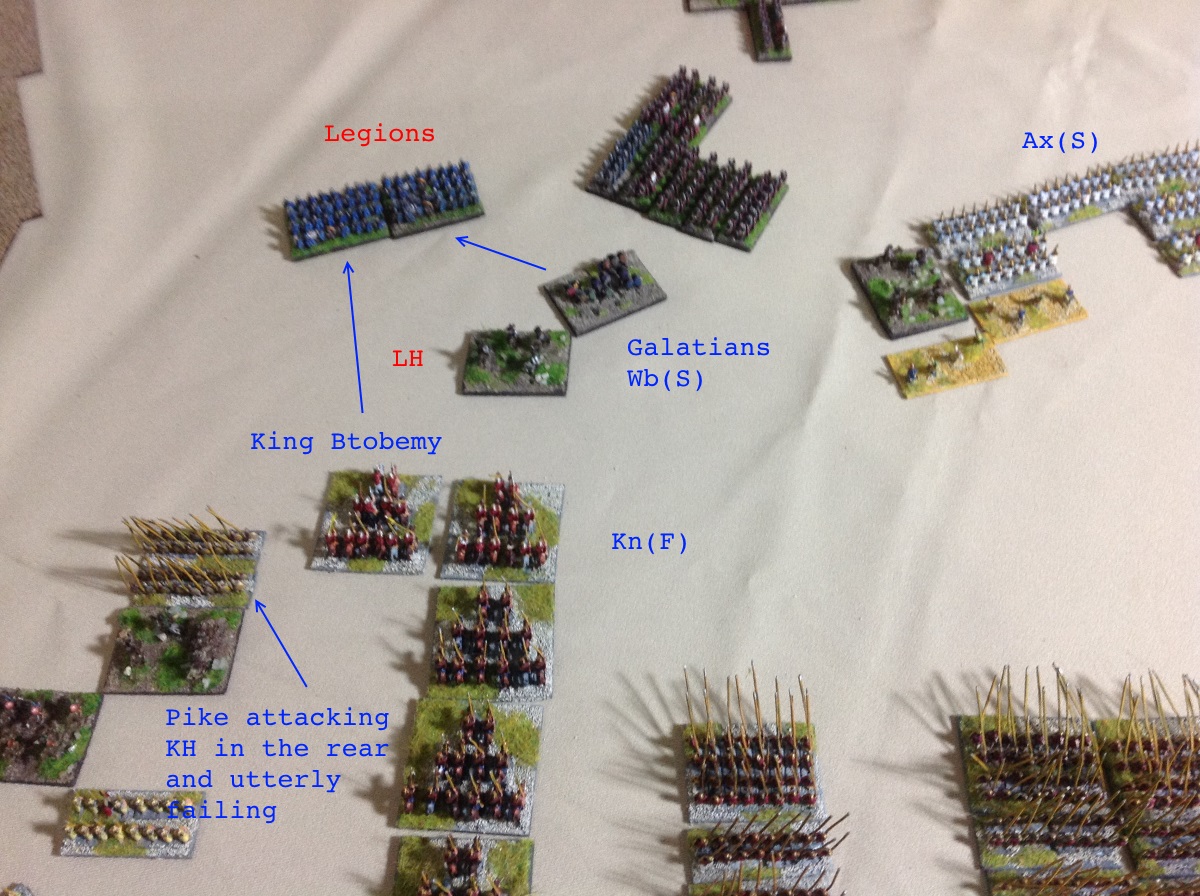
So what should I pick to defeat Nash. His Romans are a very tough versatile army, and he has a lot experience using them. It was no major weaknesses, but there are some avenues of attack. His legions might with a bit of luck be swept away by knights or warbands, the large cavalry wing he habitually employs might be defeated by knights (but not the knight wedges in my army list), and I have more difficult terrain troops. Nash was obviously well aware of the dangers posed by the Sarmatians, picking them as his top ally and thus denying them to me. I'd picked the Galatians as my top ally with the intention of using them against Nash, but elected to keep them in reserve for games in later rounds. I also thought about using a Rhoxolani command to boost my cavalry which would otherwise be outnumbered, but in the end I stuck with a three command army from my own list, very similar to the one from the last game. However, I dropped one of the elephants and instead employed 4 elements of Galation (Warband S) mercenaries to boost my chances against the legions. I spend 19 of my 34 bonus points on scouting and ambush stratagems and and additional 4 points on troops (as my total troop elements came to 402 points).

I picked two sand dunes for my terrain (as they narrow the central portion of the table more than a Waterway) and Nash had a couple of oil wells (minimum size marshes) a BUA and a gentle hill. Most of the significant terrain fell on the right side of the table, with just the hill and the oil well to the left. This gave the Romans a bit more space to run around in than I'd hoped, but at least allowed me to secure one flank the various bits of bad going on the right.

Deployment 
My plan was to crush the legions with my phalanx and Galatians, and to this end I split the Galations into two pairs with each having a phalanx block on both flanks, the idea being that the pike blocks would push things back giving the Galatians a double overlap and a great chance of a kill. The maximized my offensive potential, but meant that wheeling would be more difficult with irregulars mixed in, and I'd lose my free march move with the pikes.

I expected the terrain on the right to be lousy with Roman light troops, so decided not to waste pips fighting there, but to mask it with the peltasts from my right hand command. The cavalry from that command would be sent to assist the left, and knight wedges would also go left, or attack the legions if they overlapped the right of the phalanx. On the left was a mixed force of peltasts cavalry and a lone elephant whose job was to protect the left of the phalanx, and not to lose to quickly. Many elements were thrown forwards to delay the Romans marching around my left flank.

The Romans deployed with the legions on their left, with a small pip dump command of horde and a couple of blades on their left flank. To the right of the legions was a massed command of Roman cavalry lead by the C in C (Rollius Sixus) and an elephant. On their far left, was the surprise package, a Skythian ally with horse archers and four noble knight elements. I was quite happy to see the latter, as previous experience has shown they meet far more death than glory.

Relief Column
The game opened with the Roman cavalry advancing on my left, and the legions forming column and moving away from my phalanx. I pushed forward with the phalanx, but it suffered a dearth of pips all game, and I was never able to re-orient it properly towards the legions. On my left I withdrew my pickets, and began moving the mounted from right across to reinforce.

It was clear that this going to be one of those games that turned 90 degrees and would be fought along the long axis. With the legions getting away, I pushed the phalanx forward as fast as possible, even at the expense of allowing a flank attack on the left of the line by Roman light horse. It was 3 vs 3, but I lost and had to remove two elements of pike. Still it was a big command, and the Roman cavalry had been lured into a fight.

A messy fight now developed between the Roman cavalry and my peltasts and the leftmost elements of the Phalanx. My elephant did good work bagging a couple of horse, but the Romans had the numbers, and that began to tell. Meanwhile my phalanx command scored 1 on its pip dice for five bounds in a row (it was assigned the lowest dice, but even so it should only get a one about forty percent of the time), and in order to prevent more losses from flank attack, I had to allow the Galatians to rush off impetuously, to their doom I feared.

At this stage, things weren't looking good. My right wing wasn't in the fight, my phalanx was stalled, split into multiple groups nowhere near their target, my left flank was starting to crumble and the Skythians had finally got around the left, and their knights were poised to sweep away my cavalry at the end of the line. However, their was one glimmer of hope, in that the Roman CinC who'd been bringing the elephant up was now in line with it, and a gap in the line allowed my cavalry to flank the elephant, turning it round and placing him in the death zone. One good roll, and the elephants would stampede trampling Rollius Sixtus into the ground. Nash rolls his dice ... a one... maybe I'm still in this, but then I roll mine and it comes up two. Three would have been enough, but Rollius Sixtus lives to scurry away. All seemed lost.

Final Attack on Legion
At this point, Fortuna decided to take a hand. One pair of the Galatians who'd rushed off ahead of the army had been dispatched, but the others were nearing some legionaries. Not wanting to take any chances, Nash moved out his cavalry general in command of the legions to confront them, apparently unaware that cavalry flee from warband if beaten, and failing to leave enough space for them to fully recoil. A bad die roll saw the general defeated, forced to flee, and dying for lack of recoil space. The victorious Galatians then piled into the legionaries, killing a pair of them, and with the C in C King Btobemy himself who'd come up in support, killing another, the legionary command was broken.

Psiloi win the day
On the left my good fortune continued. The Skythain general charged into combat with my cavalry, and promptly died to a six one result. I then counter attacked flanking and killing another Skythian noble, and a dishearten psiloi attacked the Roman elephant, killing it and another Skythain noble behind. With two commands down, the Roman army was defeated, and somehow I'd won the game.

Phew !!!.


So now Btobemy is King of the Table, and awaits the challenge of Waynazab and his Nabateans.


Sunday, 12 July 2015

All Roads Lead To Damascus - Battle Report 1

Barbarians Get Awkward in the Orchard
or
Village People Go East

Report by our scribe in the field Dubius Factus.


This week saw a valiant defence of our Republic and the loss of a true Roman hero. Roman soil was soiled by filth of a barbarian horde. The Gods were with us and the horde was sent packing!

The day began well for our illustrious general, Legatus Pulcher Prope Fraxinum, who although late in years was still considered a strategic genius. The invading barbarians with their dodgy facial hair, leather fetishes, and love of anything a little fruity' were easily lead to an area heavy with orchards and steep hills, thus funnelling their advances exactly where our hero wanted them.  Upon entrapping the enemy in this constricting terrain, further advantage was gained by enticing the horde with promises of dancing and sweet drinks at the fable temple of the Blue Oyster. The Parthians in such a hurry to quench their queer desires, deployed first and Pulcher was able to take advantage. The barbarians scouted the area well uncovering our ambushes, but this was planned and accounted for.

The moustachioed villains deployed four commands with their cataphracts and horse archers on the flanks and a mass of light infantry and Psidian allies crammed into the orchard (no doubt trying to locate the fruits of Temple of the Blue Oyster!). The marvellous Romans deployed all 4 commands to their right flank with cavalry and legions ready to advance upon the unwashed heathens.  Two ambushes were prepared, one on the hill to the left flank and another in the orchard to the right flank.

The Parthians had the initiative but in an act of cowardly ignobleness, immediately turned tail (as if already in the Blue Oyster!) and tried to flee the field. Pulcher in turn was hesitant (rolling three 1s for regular commands), expecting some barbarian trickery. His ally general Rolus Asixus however, saw the Parthians retreat for what it was and was quick to charge across the field. Cavalry, Legions and Peltasts all advancing to close the gap and trap the savages.
And thus the battle was engaged. The valiant Romans pushed the attack on their right flank whilst the Parthians sought without success to escape.  On the left flank, the psiloi on the difficult hill proved enough of a distraction and hindrance to effectively negate Parthian efforts. In the centre, the Roman auxiliary were outnumbered but held on.


Having trapped the Parthians from escaping on the right flank, the Thracian light horse (o) pinned the cataphracts in place and launched an attack on the few horse archers (f) guarding their flank. The Thracians did their job and punched a hole in the Parthian line. Trapped and outflanked their days were numbered. It was then that barbarian heavy knights decided to actually fight. The CiC supported one of his brethren against sole Roman cavalry alae.  The barbarians, encumbered by their facial hair, leather and studs, were destroyed with great violence. That was enough to break their spirit!

Pulcher himself at this time stepped to the fray as he felt his years upon him. His closest aids tell us that he saw the battle was won on the right flank and his job was done, thus he wished to end his days in glory upon the field of battle. He is quoted as saying, ‘I am long in years, old beyond reckoning. The fields of Elysium await me. Let me die here in glory!’ as he charged the enemy foot.  The battle raged and he was driven back by a stubborn foe. It was while falling back that old age finally caught up with the old warrior. He slid from his horse, happy in the knowledge that his day was glorious.* / **

With the CiC fallen, his very small command broke. However, there was little effect on the army and on the right flank the Parthian CiC was fleeing with the remnants of his broken command. He was ridden down in eternal shame with his back to the enemy and his (or someone else’s) tail between his legs.  The Roman army was in a fine position to move into the rear of the enemy. The baggage was undefended and the Psidians exposed.  Alas that time favoured the barbarians this time and the battle was forced to end.

The result: a glorious victory for the Republic ***. An honourable death for a long lived and loyal son of Rome. A dark day for the invaders. And the start of a new era for the newly appointed Legatus Rolus Asixus!

*Actually, the cic was 6-1ed by the auxiliary. Now, this should not have killed him but for the fact that I for some reason reverted to DBM (not dbmm) factors! Anyway, the mistake was made and not noticed until sometime later

** It could also be that old age caught up with him as he awaited the Parthians to finish their moves!

*** It should have been a bigger victory. In the end the result was close 14 - 11 I believe.  Anthony is a newish player to DBMM and his plan was too ambitious for his irregular army. In other ways he played well though.


We were fortunate enough to interview Legatus Pulcher Prope Fraxinum prior to the engagement and discuss his plans.

Dubius Factus: Legatus, What is your opinion of the Parthian army?

Legatus Pulcher:  The Parthians have 2 strengths. The first is in their highly mobile and flexible Light Horse. The second is their Heavy Cataphracts. They may also outnumber us.

DF: Does this worry you?
LP: Worry, no. But I do have to consider their strengths and weaknesses. If the light horse envelope us then we could have problems. If the Cataphracts attack our cavalry we will be in trouble. Therefore, I must do two things: stop the LH from going around our flank, and keep their cataphracts away from our cavalry.

DF: How do you plan to do this?
LP: By choosing my ground very carefully and by attacking with a combination of troops, this forcing the enemy into my killing ground against the troops that I want them to fight.  The battlefield needs to be dense with difficult terrain to channel the enemy. If it is an open battlefield we will not be able to stop him. Our troops are better trained than the barbarians and we will be able to manoeuvre more effectively through gaps in the terrain. We will be able to reduce the battle to a small area thus negating his speed and flexibility.

DF: Are the cataphracts a great danger?
LP: Yes. They are deadly against our cavalry and against the legions. However, given the choice, I will attack them with the legions as we should win on attrition. The ideal situation though is to create a situation in which the cataphracts are unable to join battle. Our easiest targets are the horse archers. Although fast, if they can be pinned down they will be destroyed. Again, the terrain is key. We will draw them into our defensive positions in the hills and orchards.

DF: You have a choice of allies, which will you take?
LP: My first choice was to take Sarmatians as their heavy knights (kn f) will be an equal threat to the enemy knights. However, after some deliberation it was decided that this would be too much in the hands of Fortuna. My next choice was Skythians with their unnumbered horse archers, but again that was a risky choice. In the end, I chose to enlist my own nephew Rolus Asixus. With him commanding half the legions and cavalry it would allow me greater numbers and more flexibility with my commands. Regular troops are also more reliable.


DF: What is your opinion of the Parthian general?
LP: I have a great deal of respect for him - I would be foolish not to. But, he will over complicate his plan. I am not sure how, but he will. I will expect him to try to draw us into open ground, but we will force him into the hills. I also expect him to outscout us, but we will set up ambushes anyway. If he brings foot, we will outclass them. If he brings mounted, we will close the battlefield around them. Either way, we will be victorious.

DF: Legatus Pulcher Prope Faxinum, thank you and may Mars smile upon you for the glory of Rome.

LP: Thank you. Ave.